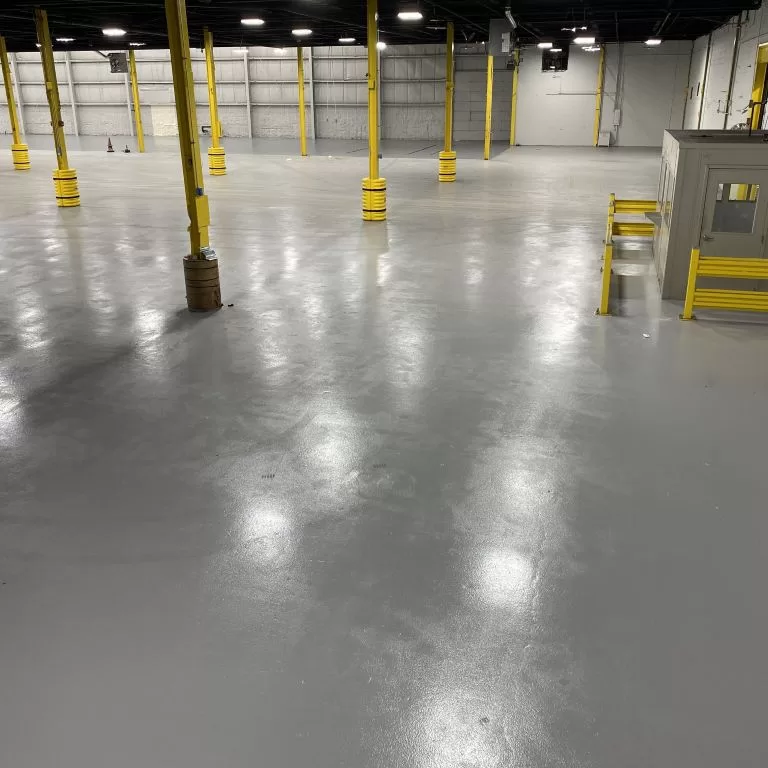
Few things put more stress on a warehouse floor than a loaded forklift making tight turns all day. The combination of weight, tire friction, and sharp pivoting creates exactly the kind of shear force that separates a well built flooring system from one that will not survive its first year.
First Establishing a Baseline for Normal Wear
Before deciding whether a floor is holding up well or failing prematurely, it helps to understand what normal, expected wear actually looks like over time. A slight dulling of gloss in the busiest aisles after a few years is completely normal and does not indicate a problem. What warrants attention is wear that exposes the substrate underneath, visible chipping at the edges of high traffic paths, or any area where the coating appears to be lifting rather than simply wearing thin. Making this distinction early prevents facility managers from either ignoring genuine early warning signs or, on the other end, panicking over cosmetic wear that is simply part of a coating doing its job under heavy daily use.
Why Forklift Traffic Is So Demanding on Floors
A loaded forklift can weigh several tons once you factor in the machine itself and the cargo it is carrying. That weight is concentrated on a relatively small tire contact patch, which means the pressure per square inch at the point of contact is significant.
Turning makes it worse. Straight line rolling puts mostly vertical load on the floor, but pivoting and turning introduces lateral shear forces that can peel a poorly bonded coating right off the concrete, particularly in tight aisles where forklifts turn repeatedly in the same spot.
Tire type matters too. Solid rubber or polyurethane forklift tires are generally gentler on coatings than steel or hard composite wheels, which can gouge a softer top coat over time.
Setting Expectations Before Installation
Any facility manager researching how well a coated surface holds up to equipment traffic should have an honest conversation with an installer about actual traffic volume, not just a general description like heavy or light. A warehouse running three shifts with continuous forklift movement needs a fundamentally different specification than one running a single shift with occasional pallet jack use, even though both might be described informally as a busy facility. Being specific about shift count, equipment type, and expected turning frequency in known bottleneck areas gives an installer what they actually need to recommend the right warehouse epoxy flooring system rather than defaulting to a generic mid range option that may underperform in the busiest zones.
Which Systems Are Built for This
Not every epoxy system is designed for heavy vehicle traffic, which is why matching the product to the actual use case matters more than picking the cheapest option.
Mortar epoxy systems are the heavy duty choice, using a trowel applied blend of epoxy resin and graded sand or aggregate to create a thick, extremely impact resistant surface. These are common in loading dock areas and forklift charging stations where wear concentrates most heavily.
Broadcast systems with quartz or aggregate filler also add durability and slip resistance while remaining more budget friendly than a full mortar system, making them a common middle ground for general warehouse floor traffic that includes forklifts but not constant heavy impact.
Standard self leveling epoxy can handle moderate forklift traffic fine, especially with a reinforced top coat, but tends to show wear faster in concentrated turning zones compared to mortar or broadcast systems.
The Role of Surface Preparation in High Traffic Areas
Even the best rated system will underperform if the concrete underneath was not properly prepared. Forklift zones in particular need thorough mechanical preparation, usually diamond grinding, to ensure maximum bond strength between the coating and the slab. A weak bond in a high shear area is where delamination starts, and once it starts in one spot it tends to spread outward under continued traffic.
Designing Around Known High Wear Zones
Experienced installers often recommend a hybrid approach rather than coating the entire warehouse with a single uniform system. General storage aisles might get a standard or lightly reinforced system, while known high wear zones, like forklift charging stations, dock approach areas, and tight turning aisles, get upgraded to mortar or heavy broadcast systems.
This targeted approach controls cost while putting the strongest material exactly where it is needed most, rather than paying premium pricing across an entire floor when most of it sees lighter traffic.
Maintenance Considerations for Forklift Heavy Facilities
Grit and debris act like sandpaper under forklift tires, so regular sweeping in traffic lanes noticeably slows down wear. Facilities with heavy forklift use also benefit from periodically inspecting tight turning zones specifically, since that is almost always where wear shows up first, well before the rest of the floor shows any sign of aging.
Balancing Durability With Cost in Traffic Heavy Zones
It can be tempting to specify the thickest, most heavy duty system available across an entire warehouse just to avoid any risk of premature wear, but this usually is not the most cost effective approach. A more practical strategy involves mapping actual traffic intensity across the facility first, identifying the small percentage of total floor area that sees the heaviest and most repetitive forklift movement, and concentrating the premium system specifically there. The remaining general storage area, which typically sees lighter and more evenly distributed traffic, can usually perform well with a standard specification at a meaningfully lower cost per square foot.
Real World Examples of Wear Patterns
Anyone who has walked a warehouse floor after a few years of heavy forklift use has likely noticed a subtle sheen difference in certain spots compared to the rest of the floor. These worn patches almost always trace back to a predictable set of locations: the tight radius where forklifts pivot to enter a specific aisle, the approach ramp where trucks transition from the dock leveler onto the main floor, and staging areas where the same pallet positions get used repeatedly for loading and unloading.
Recognizing these patterns ahead of time, before the floor is even installed, allows a contractor to reinforce those specific zones from day one rather than waiting for visible wear to appear and then reacting with a patch job. This kind of proactive planning is one of the clearest differences between a contractor with genuine warehouse experience and one who is used to smaller scale commercial or residential projects.
Load Ratings and Point Load Considerations
Beyond general traffic wear, some warehouses deal with genuinely heavy point loads, such as racking systems bearing enormous stored weight transferred through relatively small footplates, or specialized equipment with narrow wheel contact points. In these situations, the flooring system needs to be evaluated not just for surface abrasion resistance but for its ability to handle concentrated load without indentation or cracking. A mortar system with a higher aggregate content generally performs better under these conditions than a thinner, purely resin based coating.
Working Around an Active Fleet During Installation
Facilities with a large active forklift fleet often cannot simply park every vehicle for a week while the floor cures. Staging installation in sections, combined with clear temporary signage and barriers, allows fleet operators to reroute around the curing area without needing to halt operations entirely. Coordinating this schedule with the flooring contractor ahead of time, including confirming exactly which zones will be inaccessible on which days, prevents the kind of confusion that leads to a forklift accidentally driving across a section that has not fully cured yet.
Choosing Additives for Forklift Heavy Environments
Beyond the base resin system, certain additives make a meaningful difference specifically for forklift traffic. Aluminum oxide grit can be broadcast into the top coat to boost slip resistance without significantly affecting rolling resistance for wheeled equipment, which matters since an overly rough texture can actually accelerate tire wear on forklifts over time. Some facilities also request a slightly harder, more scratch resistant top coat formulation specifically in known forklift zones, accepting a small tradeoff in overall floor gloss in exchange for better long term durability where it matters most.
Discussing these tradeoffs with an installer ahead of time, rather than defaulting to a single standard specification across the whole floor, results in a system that is genuinely tuned to how the space actually gets used day to day.
Frequently Asked Questions
Do steel wheeled forklifts damage epoxy flooring more than rubber tires?
Yes, steel and hard composite wheels are more likely to gouge or scratch a coating compared to rubber or polyurethane tires, so the wheel type should factor into which system gets specified.
How thick should flooring be for a forklift heavy warehouse?
Heavy traffic zones typically call for systems in the range of sixty to one hundred twenty five mils or more, compared to lighter duty areas that might only need twenty to forty mils.
Can a standard epoxy floor be upgraded later if forklift traffic increases?
In many cases, yes. A mortar or broadcast system can often be applied over an existing floor in specific zones as traffic patterns change, provided the existing coating is properly prepared first.
Does forklift battery acid damage epoxy flooring?
Standard systems can be damaged by battery acid exposure, which is why charging stations often use a chemically resistant formulation specifically rated for that risk.
Is a textured finish necessary in forklift traffic areas?
A textured or matte finish is often recommended near dock doors and wash areas where moisture is common, since it improves traction for both foot traffic and equipment.
Leave a Reply